Blog
Breast lift workout: the exercises that help and what they cannot change

Search for exercises to lift your breasts and you will find plenty of routines that promise a perkier bust in a few weeks. Chest exercises are good for you, and they can change how your chest looks. They cannot reverse sagging, because the breast itself has no muscle to train.
This guide explains what a breast lift workout can and cannot do, gives you a simple routine you can do at home or in the gym, and covers what actually causes breasts to sag and when a surgical breast lift is worth considering.
Breast lift workout: the short answer
- The breast is made of glandular tissue, fat and ligaments. It contains no muscle, so exercise cannot tighten or lift the breast tissue itself.
- The breast sits on the pectoral muscles of the chest. Stronger chest muscles can make the upper chest look firmer and fuller.
- Upper back and shoulder exercises improve posture, and standing tall changes how the bust sits.
- Aim for strength exercises that work all the major muscle groups, including the chest, back and shoulders, on at least two days a week.
- Wear a well-fitted sports bra when you exercise. It reduces breast movement and can ease breast pain during exercise.
- Sagging comes mostly from age, pregnancy, weight changes, genetics and smoking. If your breasts have already dropped, the operation that raises them is a breast lift.
Why exercise cannot lift breast tissue
Patient.info, a clinician-reviewed health site, explains that the breasts do not contain muscle. They sit on top of the pectoral muscles, which are part of the chest wall. The breast itself is mainly glandular tissue and fat, and ligaments support it and give it shape.
Researchers in the Research Group in Breast Health at the University of Portsmouth describe Cooper's ligaments and the skin as the breast's only natural supporting structures. Ligaments can stretch, and once they are overstretched they cannot recover.
That is why a workout cannot lift the breast. You can strengthen the muscle underneath, but no exercise shortens a stretched ligament, tightens loose skin or moves the nipple higher on the breast.
What a chest workout can do
Exercise will not reverse sagging, but it can still change how your chest looks and feels:
- A firmer base. The pectoralis major is the large fan-shaped muscle under the breast. As it gets stronger, the upper chest above the breast can look firmer and a little fuller.
- Better posture. Rounded shoulders make the bust sit lower and further forward. Stronger upper back and shoulder muscles help you stand taller, which lifts the chest as a whole.
- Fitness and body shape. Strength training and activity help you keep a steady weight. Because breasts contain fat, losing a lot of weight usually makes them smaller, and repeated weight gain and loss is one of the causes of sagging.
Be wary of any routine that promises to make your breasts perkier in a set number of days. Any change you see will come from the muscle underneath and your posture, not from the breast itself.
A breast lift workout you can do at home
This routine works the chest, shoulders and upper back. You need a wall, the floor, a bench or a sturdy chair, and a pair of dumbbells or filled water bottles. If you are new to strength training, start with the easier version of each exercise.
| Exercise | Main muscles | Easier version |
|---|---|---|
| Wall push-up | Chest, shoulders, back of the arms | Stand closer to the wall |
| Push-up | Chest, shoulders, back of the arms, core | Hands on a bench or knees on the floor |
| Dumbbell chest press | Chest, shoulders, back of the arms | Lighter weights, or press from the floor |
| Dumbbell chest fly | Chest | Lighter weights, smaller movement |
| Incline dumbbell press | Upper chest, shoulders | Lower the incline |
| Bent-over row | Upper back, back of the shoulders | One arm at a time, other hand on a bench |
| Reverse fly | Upper back, back of the shoulders | Light weights or no weights |
Scroll sideways for the full table
Wall push-up
Stand an arm's length from a wall and place your hands on it at shoulder height, a little wider than your shoulders. Bend your elbows to bring your chest towards the wall, keeping your body straight from head to heels, then push back. This is the gentlest way to start.
Push-up
Place your hands on the floor a little wider than your shoulders, with your body in a straight line from head to heels. Lower your chest towards the floor, then press back up. If a full push-up is too hard, put your hands on a bench or the edge of a sturdy table, or keep your knees on the floor.
Dumbbell chest press
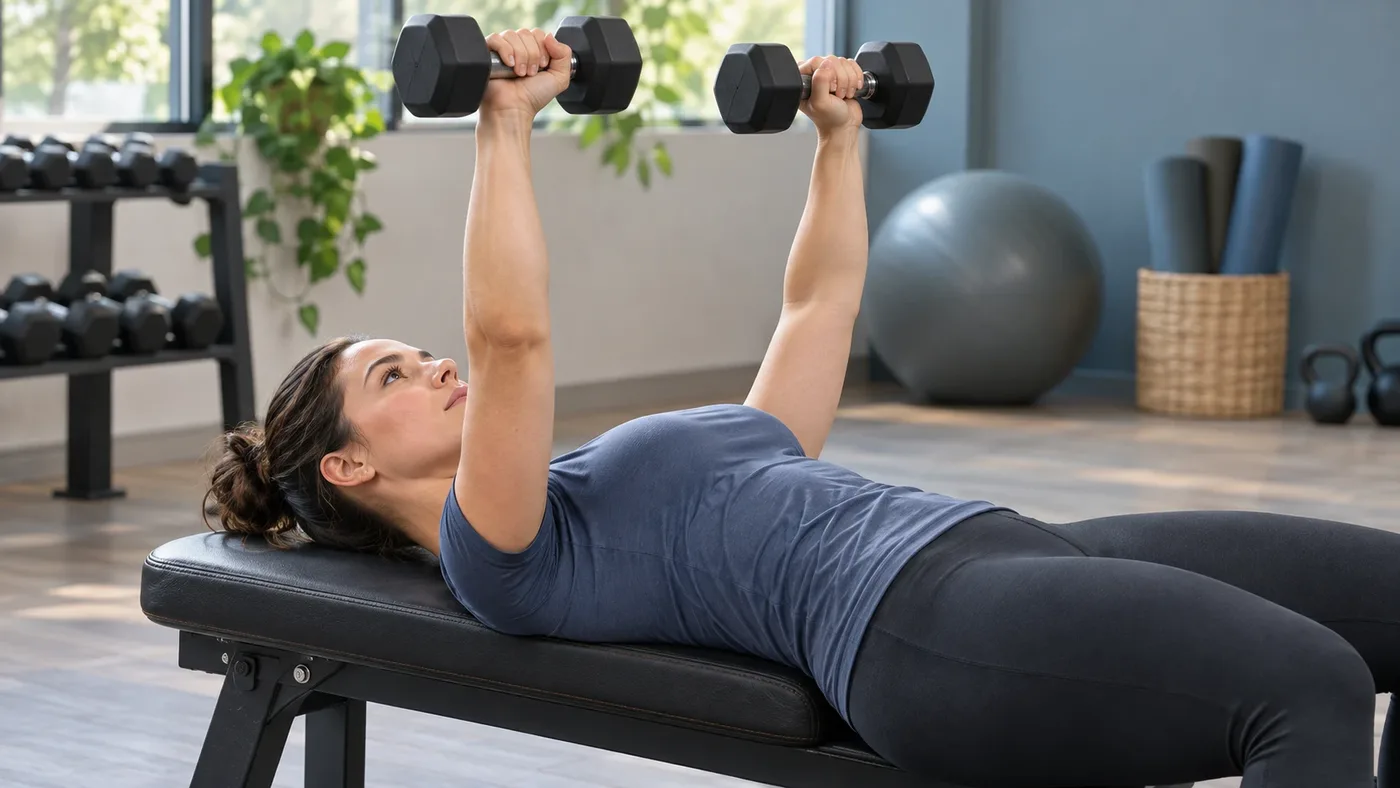
Lie on your back on a bench or the floor, holding a dumbbell in each hand at the sides of your chest. Press the weights straight up above your chest until your arms are almost straight, then lower them slowly. On the floor, your elbows stop when they touch the ground, which keeps the movement short and controlled.
Dumbbell chest fly
Lie on your back holding the dumbbells above your chest, palms facing each other and elbows slightly bent. Open your arms wide in an arc until you feel a stretch across your chest, then bring the weights back together over your chest. Use lighter weights than for the press, and stop before your shoulders feel strained.
Incline dumbbell press
Set a bench at a low incline, or lean back against a firm cushion. Press the dumbbells up from the sides of your chest and lower them slowly. The incline puts more of the work on the upper part of the chest muscle.
Bent-over row
Hinge forward from the hips with a flat back and soft knees, holding a dumbbell in each hand with your arms hanging down. Pull your elbows back past your body, squeezing your shoulder blades together, then lower the weights slowly. You can rest one hand on a bench and row one arm at a time.
Reverse fly
Hinge forward as for the row, holding light dumbbells with your palms facing each other. Lift your arms out to the sides until they are level with your shoulders, squeezing your shoulder blades together, then lower them. This works the muscles that pull your shoulders back.
How often and how hard to train
The NHS advises adults to do strengthening activities that work all the major muscle groups, including the legs, hips, back, abdomen, chest, shoulders and arms, on at least two days a week. The US physical activity guidelines give the same advice and name lifting weights and push-ups as examples.
The NHS suggests working each muscle to the point where you need a short rest before you repeat the movement. A practical way to apply this to the routine above:
- Choose a weight or version of each exercise that you can do with good form until the last few repetitions feel hard.
- Do a few sets of each exercise, resting between sets.
- When the routine starts to feel easy, add a little weight or move to a harder version.
- Leave at least a day between sessions for the same muscles.
- Combine it with exercises for your legs, hips and core, so you are working the whole body.
Stop if you feel pain in your shoulders, chest or back, and get advice before you start if you have a heart or joint condition, are pregnant or have had recent surgery.
Support your breasts while you exercise
During running and jumping the breasts move separately from the body, which is why breast pain during exercise is so common. Researchers at Portsmouth say overstretching the ligaments is thought to cause breast pain. A Conversation article by breast health researchers describes the idea that bouncing makes breasts sag as a theory rather than a proven effect, so think of a sports bra as a way to exercise in comfort.
The Portsmouth group gives these points for a good fit:
- The underband sits level all the way round, firm but not too tight, and does not slide around. It should give most of the support.
- Your breasts are fully inside the cups, with no gaping or bulging.
- The centre of the bra sits flat against your breastbone.
- The straps do not dig in or carry most of the weight.
- An underwire follows the natural crease under the breast and does not sit on breast tissue.
What actually causes breasts to sag
The American Society of Plastic Surgeons lists pregnancy, breastfeeding, weight fluctuations, ageing, gravity and heredity among the reasons breasts change shape and lose firmness, along with a loss of skin elasticity.
A study in the Aesthetic Surgery Journal looked at women who had been pregnant and were seeking breast surgery. Older age, a higher body mass index, more pregnancies, a larger bra size before pregnancy and smoking were each linked to sagging. Breastfeeding was not. The risk increased with each pregnancy.
Some of these factors you cannot change. The ones you can influence:
- Keep your weight steady. Large swings in weight stretch the skin and change the volume of the breast.
- Do not smoke. Smoking was one of the independent risk factors in the study above.
- Wear a supportive bra for exercise, for comfort and to limit movement.
Exercise before and after a breast lift
If you are planning a breast lift and also want to lose weight, tell your surgeon. Weight changes are one of the causes of sagging, so a big change after surgery can change the result.
After the operation, the American Society of Plastic Surgeons says you will wear an elastic bandage or a support bra to reduce swelling and support the breasts while they heal. It advises asking your surgeon when you can return to normal activity and exercise, because this depends on the operation and on how you heal. Chest exercises, push-ups and lifting weights put strain on the healing breasts and scars, so wait until your surgeon gives you the go-ahead. Our guide on what to expect after a breast lift covers recovery in more detail.
Once you are cleared, a chest and back routine like the one above can help you get your strength back.
When exercise is not enough
If your breasts have dropped, your nipples point downwards, or you have loose skin after pregnancy or weight loss, exercise will not change that. The American Society of Plastic Surgeons describes a breast lift as an operation that raises the breasts by removing excess skin and tightening the surrounding tissue. It does not significantly change breast size. If your breasts have also lost volume, a lift can be combined with implants, which our guide to breast lift vs breast implants explains.
Non-surgical options have limits too. Breast lift tape holds the breasts higher only while you wear it, and the PRP injections sold as a vampire breast lift do not lift the breast either. Our breast lift page explains the operation, and you can read about a breast lift in Turkey if you are considering surgery abroad.
Can exercise lift sagging breasts?
What exercises help lift breasts?
How long does it take to see results from chest exercises?
Do push-ups make your breasts perkier?
Can chest exercises make my breasts smaller?
Does running without a sports bra make breasts sag?
When can I exercise after a breast lift?
Is a breast lift the only way to fix sagging breasts?
Medical disclaimer
This article is informational, not medical advice. Always consult a licensed physician about your individual case before booking any procedure.