Blog
Dental Bridge vs Implant: Which Is Right for You?

Published 13 July 2026 · Last updated in September 2026

Dental Bridge vs Dental Implant at a Glance
| Dental Bridge | Dental Implant | |
| Support structure | Relies on the two neighboring teeth | Stands on its own, fused to the jawbone |
| Neighboring teeth | Must be filed down to hold crowns | Left untouched |
| Jawbone | Doesn't stimulate the bone; bone loss continues | Preserves bone through osseointegration |
| Procedure time | 2–3 weeks, 2 appointments | 3–8 months, including healing time |
| Typical lifespan | 7–15 years | 20+ years, often permanent |
| US average cost | $2,000–$4,500 | $3,500–$6,500 |
| UK average cost (private) | £750–£2,400 | £1,800–£3,500 |
| Abroad average cost | Roughly 50–65% less | Roughly 60–70% less |
Scroll sideways for the full table
What Is a Dental Bridge?
A dental bridge is a fixed prosthetic that "bridges" the gap left by a missing tooth. It's made up of a false tooth, called a pontic, that's anchored in place by crowns fitted over the healthy teeth on either side of the gap. Because the bridge is cemented rather than removable, it looks and functions much like a natural row of teeth.
There are a few variations worth knowing:
- Traditional bridge — the most common type, using crowns on both neighboring teeth to hold the pontic in place.
- Cantilever bridge — anchored to a crown on only one side, used when there's just one healthy tooth next to the gap.
- Resin-bonded (Maryland) bridge — a more conservative option that uses a metal or porcelain framework bonded to the back of neighboring teeth, avoiding the need to grind them down as heavily.
- Implant-supported bridge — a hybrid approach where the bridge is anchored to implants rather than natural teeth, often used to replace several teeth in a row without loading the neighboring teeth at all.
The tradeoff with a traditional bridge is that the supporting teeth have to be reshaped and capped, even if they were perfectly healthy beforehand. That's permanent — those teeth will always need a crown from that point on.
What Is a Dental Implant?
A dental implant replaces the entire tooth structure, not just the visible crown. A small titanium or zirconia post is placed directly into the jawbone, where it fuses with the bone over a period of months in a process called osseointegration. Once it's fully integrated, an abutment and a custom crown are attached on top, giving you a replacement tooth that's anchored the same way a natural tooth root is.
Because the implant post takes the place of the missing tooth root, it also keeps stimulating the jawbone every time you bite and chew, which is something a bridge or denture can't do.
Dental Bridge vs Dental Implant: 6 Key Differences
1. The Procedure and Timeline
A bridge can usually be completed in two visits over two to three weeks: one to prepare the neighboring teeth and take impressions, a second to fit the finished bridge. An implant is a longer process. It typically involves a surgical placement, three to six months of healing while the bone fuses to the post (longer if a bone graft is needed first), and a final visit to attach the crown. If you need the gap closed quickly, a bridge has the clear edge; if you can plan a few months ahead, an implant is worth the wait for most patients.
2. Durability and Lifespan
This is where the two options diverge the most. A well-maintained bridge typically lasts 7 to 15 years before the crowns need to be replaced or the bridge needs to be redone. A dental implant, once it has successfully integrated with the bone, is designed to last 20 years or longer — many patients keep the same implant post for life, with only the crown on top needing occasional replacement after a decade or two of wear. Over a 20-year period, that difference can mean redoing a bridge once or twice, versus touching up an implant crown a single time.
3. Effect on Jawbone Health
When a tooth root is missing, the jawbone underneath it starts to shrink from lack of stimulation — a process that continues indefinitely with a bridge or denture. An implant post replaces that missing root, so the bone keeps receiving the pressure it needs to maintain its density. This is one of the main clinical reasons dentists tend to recommend implants over bridges when a patient is a good surgical candidate: it's not just about the tooth, it's about preserving the shape of the jaw and face over the following decades.
4. Impact on Neighboring Teeth
A traditional bridge requires the two adjacent teeth to be ground down to accept crowns, even if those teeth had no problems to begin with. That's irreversible, and it puts extra long-term load on those teeth. An implant is self-supporting and doesn't touch the neighboring teeth at all, which is a significant advantage if those teeth are healthy and you'd rather leave them that way.
5. Maintenance and Daily Care
Bridges need extra attention to keep the area under the pontic clean, usually with a floss threader or a water flosser, since regular floss can't get underneath a fixed bridge the way it can between natural teeth. Implants are cared for essentially like a natural tooth, brushing and flossing normally, though the gum tissue around the implant still needs to be monitored for a condition called peri-implantitis, which is the implant equivalent of gum disease.
6. Cost
In the US, a dental bridge typically runs $2,000–$4,500 depending on the number of units and materials, while a single dental implant (post, abutment, and crown) typically runs $3,500–$6,500. In the UK, private bridges range from roughly £750–£2,400 (higher in London), and a private implant typically runs £1,800–£3,500, with a median around £2,500. The NHS covers a basic bridge under a capped Band 3 charge in England (around £332), but implants are only NHS-funded in specific medical circumstances, not for routine tooth loss.
On the surface, a bridge looks cheaper. But because it usually needs to be replaced at least once within 20 years while an implant often doesn't, the lifetime cost gap narrows considerably, and in some cases reverses, once you factor in the cost of redoing a bridge down the line.
Pros and Cons at a Glance
Dental bridge
Faster to complete, usually in two appointments
- Lower upfront cost
- No surgery required
- Well-suited for patients who aren't good candidates for implant surgery
- Requires healthy neighboring teeth to be reshaped
- Doesn't prevent jawbone loss
- Needs replacement roughly every 7–15 years
Dental implant
Preserves jawbone density long-term
- Doesn't affect neighboring teeth
- Can last 20+ years, often a one-time investment
- Feels and functions closest to a natural tooth
- Longer treatment timeline (months, not weeks)
- Requires adequate bone density (or a bone graft)
- Higher upfront cost
Who Should Choose a Dental Bridge?
A bridge tends to make sense if you want the gap closed quickly, if the teeth on either side of the missing tooth already need crowns for other reasons, if you'd prefer to avoid oral surgery, or if you don't currently have enough jawbone density to support an implant and aren't able to undergo a bone graft. It's also a reasonable option if budget is the deciding factor and a shorter-term solution is acceptable for now.
Who Should Choose a Dental Implant?
An implant is generally the better long-term investment if the teeth next to the gap are healthy and you want to keep them that way, if you're looking for a solution that won't need to be redone in a decade, or if preventing bone loss in the jaw matters to you, which it should, since bone loss can eventually change the shape of your face and make future dental work more complicated. You'll need enough bone volume to support the post (or be willing to have a bone graft first), and you'll need to be comfortable with a treatment timeline measured in months rather than weeks.
For many patients, the honest answer is that an implant is the better outcome clinically, and the bridge becomes attractive mainly because of the shorter timeline and lower sticker price at home.
Why the Cost Comparison Looks Different Once You Look Abroad
The price gap between a bridge and an implant in the US or UK is a big part of why so many patients default to the "cheaper" option, even when an implant would serve them better long-term. But domestic pricing isn't the only benchmark. Accredited clinics in countries like Turkey, Spain, and Mexico routinely deliver the same implant systems (Straumann, Nobel Biocare, Osstem) and the same lab-fabricated bridges, using dentists trained to the same international standards, at a fraction of US or UK prices.
| US | UK (private) | Abroad (e.g., Turkey) | |
| Dental bridge (per unit) | $2,000–$4,500 | £750–£2,400 | Roughly 50–65% less |
| Dental implant (per tooth) | $3,500–$6,500 | £1,800–£3,500 | Roughly $400–$1,100 |
Scroll sideways for the full table
That gap is large enough that many patients who assumed an implant was out of reach find that traveling for treatment brings it in line with, or below, the cost of a bridge at home, without giving up the 20-year lifespan and bone-preserving benefits that make implants the stronger long-term choice.
The catch is that quality varies enormously between clinics abroad, and researching accreditation, dentist credentials, and warranty terms on your own is time-consuming and hard to verify from a browser search. That's the specific problem Flymedi was built to solve: it lets you compare vetted, accredited dental clinics side by side (pricing, dentist qualifications, patient reviews, and what's included) and request free, no-obligation quotes before you commit to anything. If Turkey is on your radar, the complete guide to dental implants in Turkey is a good next stop for what the trip itself actually looks like.
There's no universal right answer between a dental bridge and a dental implant — it depends on your bone health, your budget, your timeline, and whether you're willing to modify healthy neighboring teeth. But for most patients who are good surgical candidates, a dental implant is the stronger long-term choice: it protects your jawbone, leaves your other teeth alone, and is built to last decades rather than years.
If cost has been the deciding factor pushing you toward a bridge, it's worth comparing accredited clinics before ruling an implant out — the price difference may be smaller than you expect.
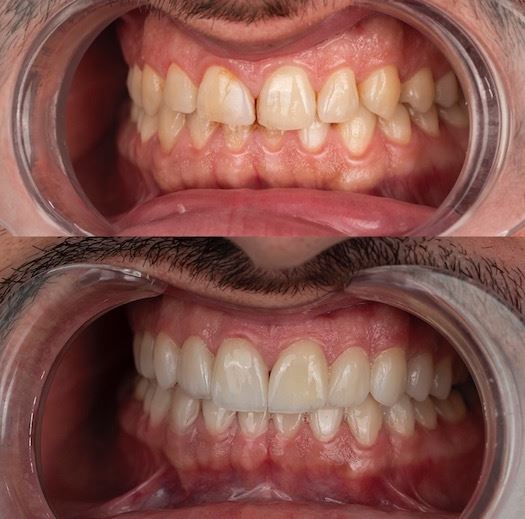
Before / After


.webp)




Take The First Step Get Started!
Our team will dedicate their effort and time to help you choose the clinic best for you. Our goal is not just to find ‘a doctor’ for you, but to find ‘the right doctor’.
Medical disclaimer
This article is informational, not medical advice. Always consult a licensed physician about your individual case before booking any procedure.